


Photography Brooke Somerville
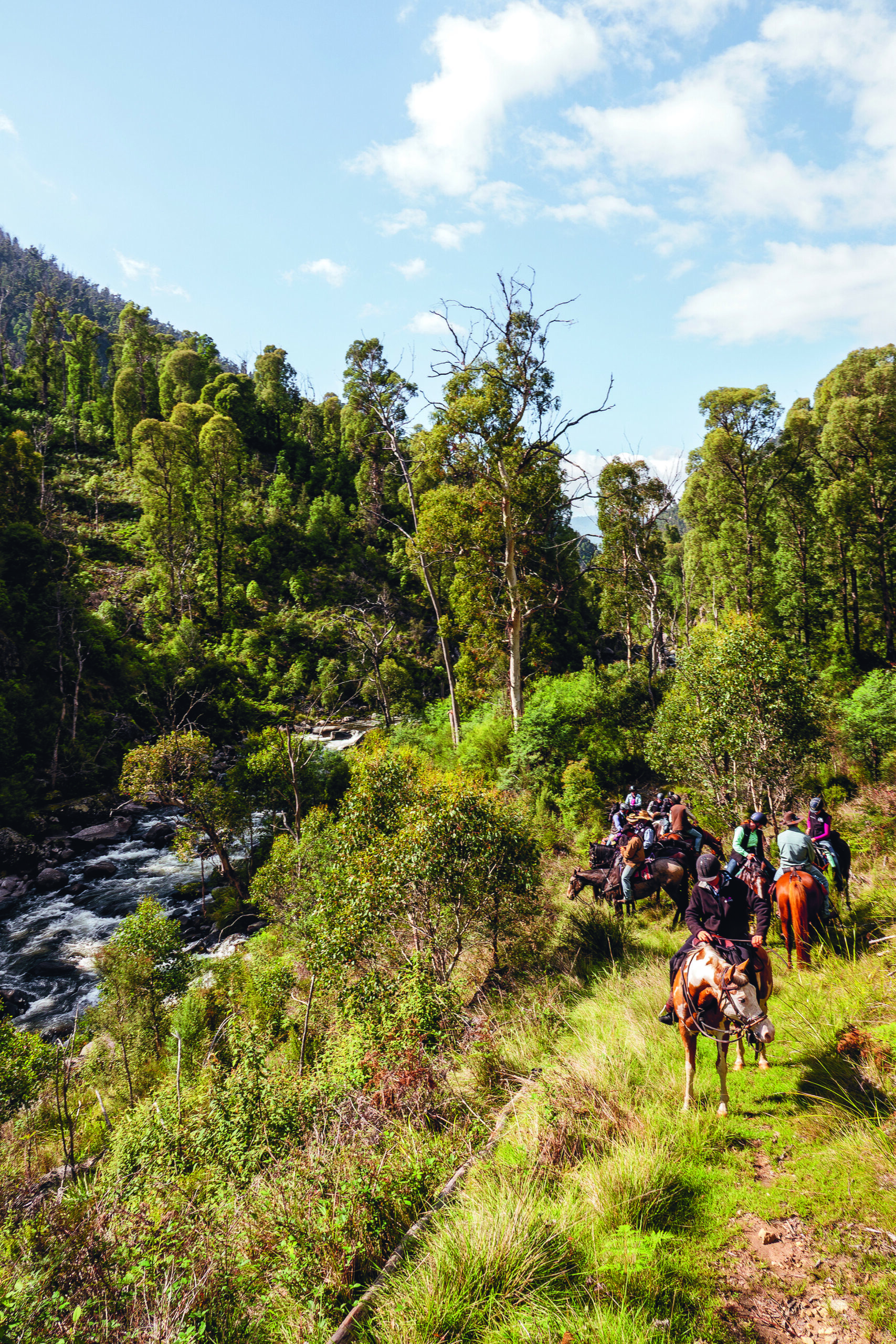
Along the trail, the riders made several crossings of the Indi River.
Sign up to our mailing list for the best stories delivered to your inbox.
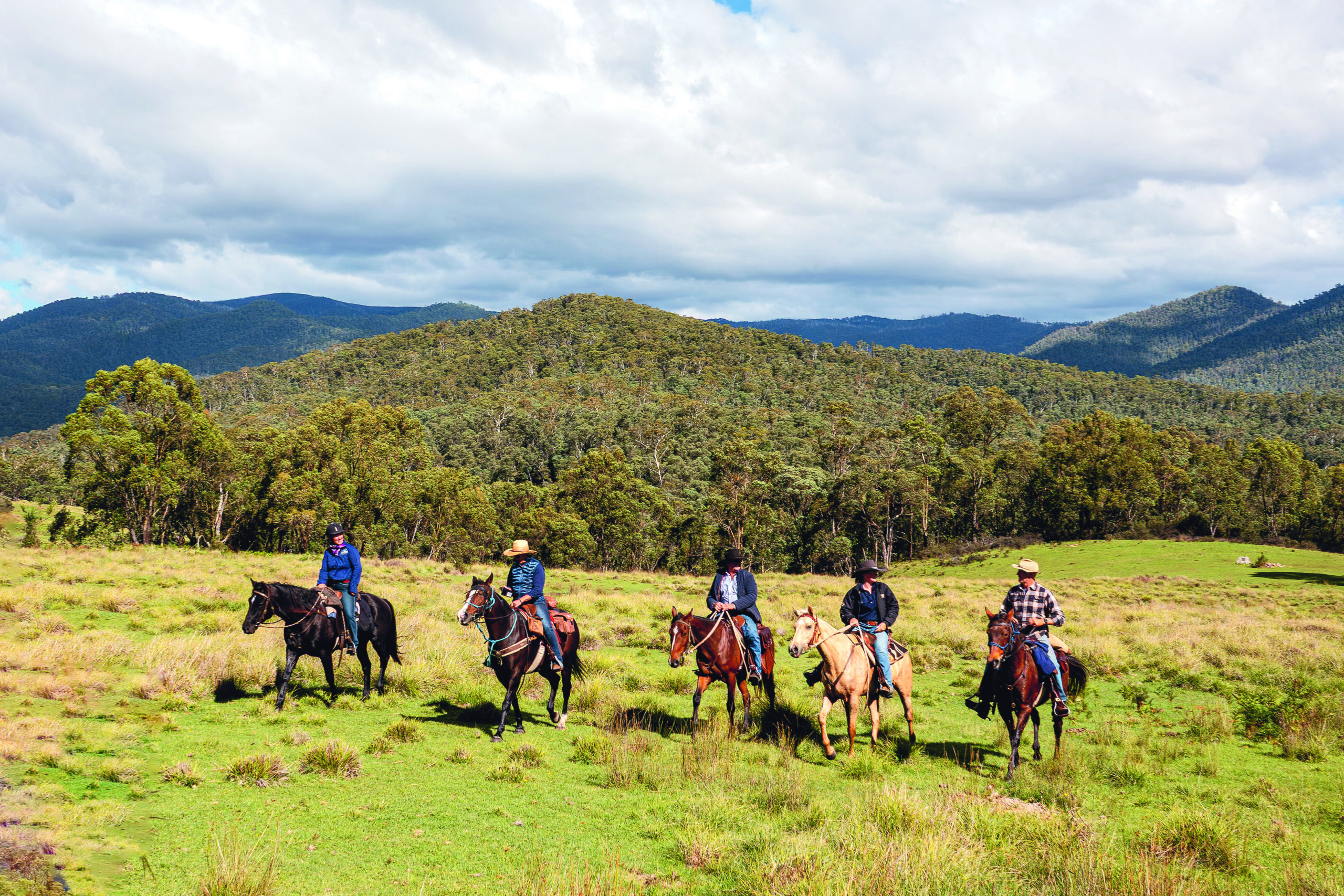
With a five-day ride through the country of her childhood dreams, Maggie MacKellar and her horse Frank tackle the path of The Man from Snowy River.
Words Maggie MacKellar Photography Brooke Somerville
AT THE BEGINNING of the year my friend Lib asked if I wanted to come with her on a five-day ride in the Snowy Mountains, leading up to The Man From Snowy River Bush Festival. Her friend had dropped out and there was a spare spot on the ride. All I had to do was say yes and get my horse Frank and myself fit. I knew by the fizzing in my head that saying yes was going to take me out of my comfort zone. I also knew how unlikely it was that such an opportunity would ever come again. Now, on the other side, I know both things were right.
It’s dusk when we wind our way back into Victoria and turn off the highway. The horses have been travelling for 28 hours, with stops to get them off the float. We had left Tasmania on the ferry to cross Bass Strait the night before, driven up the Hume Highway and into New South Wales before looping east and south to finally arrive back in Victoria at Tintaldra Station in the Upper Murray valley. We unload Leo and Frank, give them their dinners, pop their jumpers on, fill their hay nets, and all of us take a collective breath. We’ve made it to our first stop.
Leo is a little off his feed and wants to meet his new neighbours. Frank tucks in like the Labrador he is, until he sees the most enormous pet pig grazing in the paddock beyond the yards. Cue snorting and high jinks. I’m relieved: he’s feeling well. Our support crew have taken themselves up to the house. We meet them on the verandah for a congratulatory toast; the first leg has been accomplished. I try and take in this view, the river and rich flats, the black cattle and a glory of sky and mountains.
There’s a poem I have pinned to my corkboard that encourages me to keep writing when it all feels pointless. It’s by the American poet Sean Thomas Dougherty and it’s called ‘Why Bother?’ The poet’s answer is to describe someone out there, a reader, who has a wound in the exact shape of my words. That’s why we bother. This is a strange poem to recall when I’m telling you about this trip, and yet this poem comes to mind now, not because of what I’m writing, but rather in recognition of the writers who have written for me.
Stay with me, because I have to go right back to my childhood and the words of writer, conservationist and farmer Elyne Mitchell. Many of you will have read Mitchell’s iconic series, the Silver Brumby, about a mob of wild horses living deep in the Snowy Mountains. I knew these books off by heart. At the end of the first book, Thowra finds a Secret Valley (yes, capitals) where he is safe from the men hunting him, and from the other stallions trying to claim his beautiful mares. The only way you can reach this place is via a steep and deadly cliff. I absorbed that valley: it became the shape of my small wounded heart. It was my safe place too.
Tintaldra, where we’re staying, is very close to where Elyne Mitchell lived. I’m finally in the country she gifted me: the Ramshead Range, Dead Horse Gap, Tom Groggin, Khancoban, the Grey Mare and Tin Mine huts, Crackenback River, Swampy Plain River, Indi River. The names, a litany, are places that previously were only alive in my imagination, a whole landscape into which I would escape through Mitchell’s words. And here I was, on the edge of them.
Photography Brooke Somerville
Along the trail, the riders made several crossings of the Indi River.
Photography Brooke Somerville
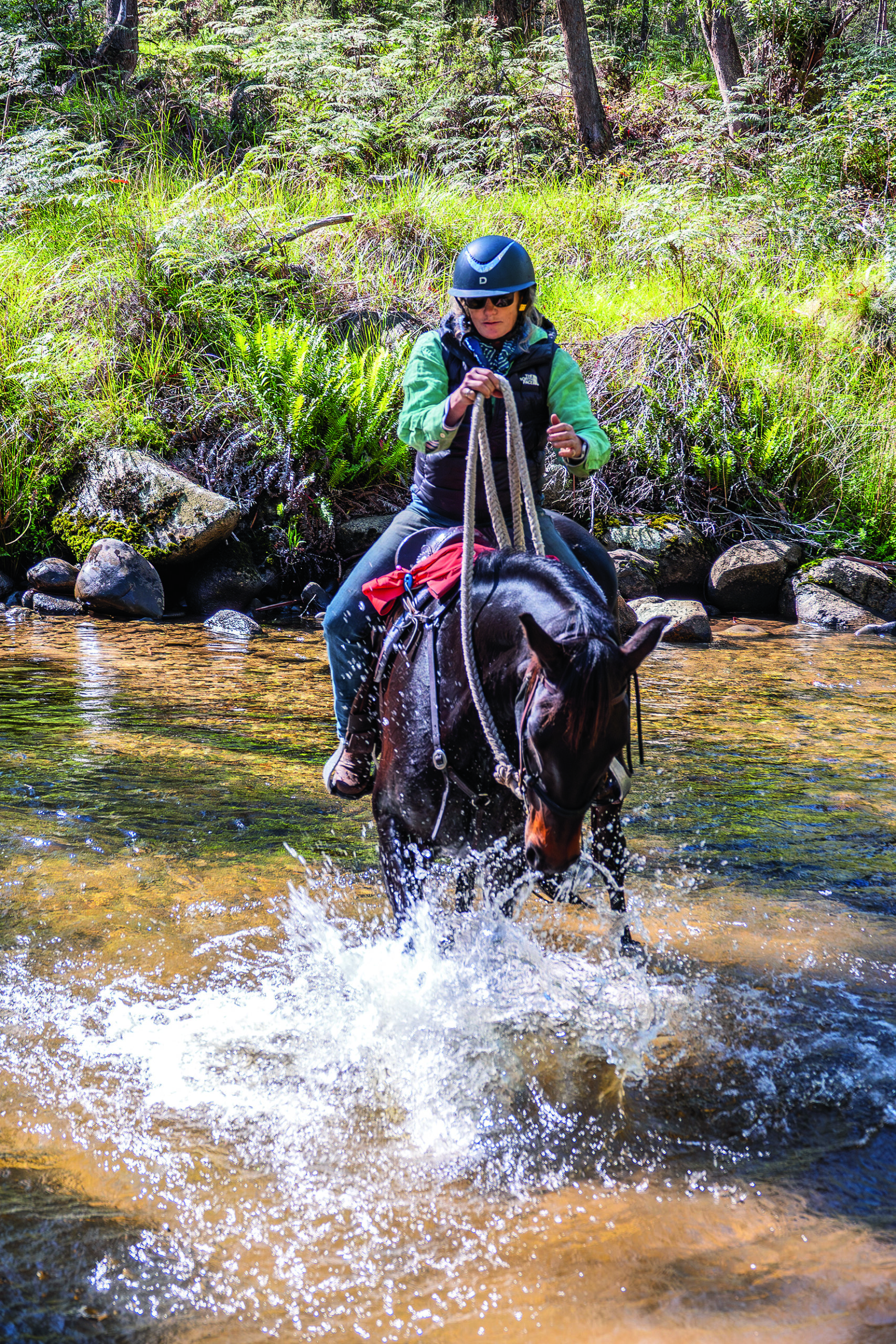
Maggie and Frank ford the river.
SUNDAY APRIL 12TH
Tintaldra Station
In the afternoon we saddle the horses and ride out with Lib’s friend Al Mackinnon. We follow the track below the house down to the flats, and there is the Murray, the weft and weave of it, gentle and lazy. The horses are fresh. Leo is jogging, snatching at his bit. Frank looks calm on the outside, but underneath he’s doing his impression of a powder keg waiting for a match to light his fuse. I relax my body, deliberately put a loop in the reins and start to look for the birds. There are pelicans on the billabong; a white-faced heron steps carefully through the shallows. Al, ever the farmer, decides we can do a job while we’re out, and in the golden afternoon light we gather a mob of heifers grazing along the river. Riding behind the cattle I think of a question the Irish poet Pádraig Ó Tuama uses as a guiding prompt in his workshops: when do you feel most alive?
Now, I think, I feel most alive now.
Back at the yards, we unsaddle and the horses steam in the falling light. Lib and I mix their feeds and put them in a bigger paddock with a view up to the main range. When I let Frank go, he stands for a moment and then, staring at the mountains, plunges forward, flipping his hind legs in the air.
MONDAY APRIL 13TH
Tintaldra to Tom Groggin Station
Today is the day we are to go up to the mountains.
Lib and I have been training for this for months. We’ve got ourselves, our blokes and our horses across Bass Strait. The nerves have returned in force as we get up early and meet Al in the kitchen for another ride.
The morning is crisp and promises a day of gold and blue. Frank is getting the hang of everything being new, and he strides along. We ride down the road to the new Tintaldra Equine Arena. It’s perfect. We trot and canter and the tightness melts as we both start to sweat. When we ride back through the little town, along the river and past the pub, the horses have their necks long and low and I can look around me, my hips loose, my feet out of the stirrups.
While Frank has breakfast I wash the sweat out of his coat, wash his mane and tail, scrub his face and then, in the mild autumn sunshine with the mountains rising steeply behind us, Lib and I clean our gear. When everything is ready, we head back to the house; I feel 10 years old and 53 years old, the two parts of myself joined up. Tonight we will camp in the mountains at Tom Groggin Station.
On the road to Tom Groggin, passing Towong Hill, over Bringenbrong Bridge, just below where the Indi and Swampy Plains rivers become the Murray, past the sign to Tooma. Up and up we go. After Khancoban the country gets steeper and, by the time we turn off the highway and roll into Tom Groggin Station, I’m almost mute with overwhelm.
The camp is set up on an open river flat. There’s a big kitchen tent and a huge pile of logs pushed up for a fire when the cold settles, but for now the scene is idyllic. Green grass, blue sky, the river running below the camp and horses and humans of every shape and size. Lib and I lower the tailgate, and when I see Frank the nerves vanish. My plain brown horse looks out at the scene, takes it all in and then steps calmly down the ramp, and there’s only the heady rush of anticipation.
Lib and I saddle up. We must take our horses up for a vet and gear check. We walk through the controlled chaos to the vets. Frank is astonished at the coloured horses, at the golden horses, at the pretty grey horses. Such a scene! Both the lads passed. We’re approved to start.
We settled them into their tightly strung yards (no prizes for guessing that two farmers had put our yards together). It had been a perfect autumn day, but as soon as the light turned deep gold and the sun sank low we could feel the mountain chill.
We have dinner by the huge fire, meet some of our fellow riders and then walk back to our camp to check the ponies and get into bed. Frank has polished off his feed and licked his plate clean. I give him more chaff and set my alarm. Lib and I are in the first group out, riding at 8am. We want to be up early to give the horses time to graze.
TUESDAY APRIL 14TH
Tom Groggin to Buckwong Creek and back, via Jack Riley’s hut
I wake before the alarm and pull on jeans, jumper, vest, beanie, boots and fingerless gloves. Everything is muffled by thick fog. The air, heavy with moisture, hangs in the beam of my head torch. Lib is up too, and we mix Frank and Leo’s breakfasts. While they eat, we take coffee and a plunger up to the mess tent. A fire heats two huge kettles. Nothing is as good as that coffee, black and thick. I warm my hands around the enamel mug as the sun starts to push through the fog.
Today is meant to be an easier day, a chance for the guides to have a look at our horses (and us) to see if we’re up to tackling Day Two — Harrington’s Track. It’s still a seven-hour day, around 30 kilometres, and the biggest challenge is the first (of what will be many) river crossings. We’re ready on time and Lib and I walk up to meet our group. I wait until the last moment to swing up into the saddle. I know the strangeness of it all will have Frank on his toes as soon as I get on.
We cross the river, walking straight up the middle, the water up to Frank’s chest. Then we’re up the other side and into the bush. Frank has a fast walk that keeps him near the front. He strides out beneath me, doesn’t jog, which pleases me. We climb until we reach Jack Riley’s hut. We pause on the edge of the bush for our first sight of brumbies: a mob grazing on sunny meadow. Behind them the mountains fold back on themselves.
There’s so much history here. Riley is thought to be the inspiration for Banjo Paterson’s poem ‘The Man From Snowy River’. Paterson stayed here. The romance of it runs close to the surface. The hut site is on a little knob, with a huge view away to the cleft of the river running down the valley and the meadow behind. It’s something extraordinary, to be here on our horses, watching the brumby mob, who are watching us.
On the way in to lunch, the head guide, who is also the manager of Tom Groggin and a renowned stockman, flicks his fingers to the left and I look and there in the trees is a young brumby. It stares at us for a moment and then melts into the trees, as if it was never there.
Lib and I are both thrilled with our horses. Frank hasn’t even cracked a sweat. After lunch we get going again and I’m thinking that this couldn’t be going any better. We come to a river crossing. The rider in front of me yells something I don’t hear. We negotiate the crossing and Frank leaps up the bank. Then suddenly, at the top of the bank, he starts plunging, stamping his feet, his head down, as if he has caught his front legs through the bridle. I sit still. Then he gets serious, plunging forward, his back high under me. For a moment I think I’m in real trouble. I yell and he stops. But he’s shaking and agitated. I turn around and see the bright yellow of European wasps swarming. They’re all over his rump, violent yellow bright against his dark coat.
Behind me, chaos. Horses are plunging and bucking. Two people come off — well, one sort of steps off because his horse just sits down. I urge Frank up the hill but the wasps keep following us. He’s really upset but keeps his head. I don’t want to get off in case he kicks me when he’s kicking at a wasp. I stop at the top. “Mate,” I say, and stroke his steaming neck. Somewhat miraculously, everyone is okay. It could have been so much worse.
The head guide stays back to cut another track for a different river crossing so the rest of the ride doesn’t face the angry wasps. We cross the river back into camp and I slide off my upset horse. I can see welts all over him, on his flank, under his neck, on his face. The support crew have to do some supporting so I can un-saddle him. I cool him off and the water seems to help. The vet gives him a steroid and anti-inflammatory to calm his system. It works, and he softens and starts to graze.
Of all the scenarios I had imagined where I might have hurt my horse (think broken legs, travel sickness, colic, etc), an attacking hive of invasive wasps was not among them.
Tomorrow is the toughest day. A steep climb and then a very narrow track with an awful drop off. Not a day to have an uptight horse. There’s a choice here, to go forward or pop Frank on the float and meet the ride where they arrive tomorrow night. Obviously, this would be devastating. No use worrying about it, I’ll see how he is in the morning.
I take myself to the river. It’s quiet. No-one is down here. I strip and get in. It’s flowing well and though I’m braced for the cold, it’s not there. I feel the suck of mud, then the uneven stones, my body hideously awkward, thick with the day and then the river deepens and takes me, washing it all off.
Somewhere in the evening, under the slash of bright starlight, the flames of the pushed-up fire, the goosebumped reciting of a famous poem by an Irishman — his other-world lilt a reminder of our stranger status here — I remember something my daughter said about treating horses. They read your intent. Frank, despite his distress, won’t hold the wasps against me. Tomorrow and the test of Harrington’s Track, will be okay.
WEDNESDAY APRIL 15TH
Harrington’s Bridle Track
Whether it was the river or just general exhaustion, I slept. There was no kicking a podcast into gear at 2.30am, no anxious thinking at 4am; just the sound of the river, horses cropping grass and a magpie’s wobbly warble at the slightest hint of light.
Lib and I gave Leo and Frank their breakfasts and walked to the kitchen fire for coffee and eggs. Again, the day promised to be magnificent, the sun already burning off wisps of mist, a hint of warmth as it touched the back of our shoulders. The mountain grew as the mist burned off.
For many people this ride is a pilgrimage. There are father/daughter, son/father and mother/daughter combinations. There are young people, supported by their mothers. There are people on tough little brumbies, people on beautiful homebreds, people on retrained racehorses. Everyone has a story as to why they’re here. Looking at the mountain, the buzz of conversation and nervous energy behind me, I wonder what’s my pilgrimage.
After breakfast we take Leo and Frank to graze. I love watching how deliberate they are in what they choose to eat: yes to this variety of grass, no to another. Frank finds a dead Scotch thistle and stands for minutes delicately picking off the vicious seed heads, any one of which would draw blood if I attempted the same. We saddle up. I already know Frank will be his normal calm self. You can see the welts on his coat where he’s been stung by the wasps, and some of them are starting to pus up, but he’s unbothered and when we walk out of camp, it’s my sensible forward horse I’m riding.
We ride up the valley out of Tom Groggin and start to climb into the thin blue air. The horses, their great hindquarters straining, surge. They use their front legs like crampons, digging in their toes. I balance in the stirrups, my weight out of the saddle, low over Frank’s wither. Higher and higher. The trees change. They grow quieter, straighter, fire-scarred, their girths impossibly wide. Their trunks rise in worship, while their roots draw another universe below. A pattern of leaves falls on the raised veins of my horse, his coat slick with sweat, his nostrils flaring at the holiness. I put my hand on his neck. Here I am, my small soul caught by beauty, an anchor into something beyond my understanding.
The river runs far below and we follow, nose to tail, a narrow track squeezed against the mountain’s rump. This is the place where you wouldn’t want to be riding a horse who fizzed. Frank is cool. He picks his way, so sure-footed. Below us the river rips and pours and then, as if we could not be any more in this place, the wild dogs start to howl from the other side of the valley. If I’m on a pilgrimage, I’ve found my Mecca.
Slowly we leave the high-up magic and ride down through the rich mountain valleys, past black cattle fat and sassy. We’re coming back to the ordinary, we’re coming back to relationships and interactions, and I have to draw my skin over my soul.We reach camp at Bunroy Station. There’s another huge pile of pushed up logs. There’s clover over the horses’ fetlocks. Our support crew have set up brilliant yards and are settled into their other job of solving the problems of the world over a cold ale. We feel closer to the settled country. When we camp tomorrow night we’ll only be a day’s ride out of Corryong.
THURSDAY APRIL 16TH
Bunroy to Damms Camp
Highlights: riding the steep drop into the Indi; riding down the river; riding up and over the range to our last camp spot. This was another steep climb that Leo and Frank would have liked to have accomplished without the constrictions of staying with our group. Tonight is the last night we camp out together. There are awards and trivia and a general sense of accomplishment.
FRIDAY APRIL 17TH
Damms Camp to the Re-enactment, then to Corryong
Today we ride into Corryong via The Man From Snowy River Re-enactment. I confess to being hazy as to what this is: I know horseman Guy McLean puts on a performance, I know we ride down and are greeted by the crowd. I have no expectations of the whole thing. It’s a different feeling, riding in a big mob and not the smaller groups of the last three days. Frank is near the front, walking fast but not fussing. Lib and Leo are striding out, Leo just where he likes to be, leading the charge. There’s a lot of energy riding in this big group. I can feel it, the horses can feel it. We come out of the bush and wait for the Re-enactment to be ready for us. Way in the distance is an absolute sea of cars: there’s bunting and loudspeakers and so many people.
We ride down the hill in pairs and it must be a sight, 50-plus horses and riders streaming out of the bush, into the amphitheatre of the valley. That iconic music from The Man From Snowy River movie blasts from the speakers. It’s corny and also surprisingly emotional. The crowd clap. Frank is on his toes. Never has he been in such an atmosphere. They read out our names and then we turn and, as the music plays again, walk past the cheering crowd to the cattle yards.
Frank jogs, a small bomb of just contained energy. I don’t try and stop him; he’s been so good and this is a lot. When we get to the yards I get off with a little sigh of relief. We give the horses a drink and tie them to the fence. They bus us back to the Re-enactment and we sit on plastic chairs in the bright blue day and watch a wonderful show.
When we get back to the yards Frank has spent a relaxing hour contemplating the fence. We ride down the busy road and there are cars and buses and police and flashing lights and my little horse looks at it all with his eyes out on stilts. We couldn’t be in a more different environment to the quiet of the bush, but I pop him in behind some nice calm ponies and try to avoid the ones not coping. We stop at the cemetery that is Jack Riley’s final resting place for a little ceremony, and then ride into Corryong and the crowds.
The festival is in full swing. And though it’s wonderful, none of it matters compared to where we’ve been. Because where we’ve been is blue air and the tang of eucalypt. We’ve felt the pull of a river over stones and heard the howl of wild dogs. We’ve been patterned by stars and blessed in a cathedral of trees. Under it all is the swing of my horse’s stride. The truth of it breaks over me: I’ve sat in beauty, that intangible thing. When I slide off my plain brown horse, I’ll write it all down and gift it to whoever else might need to catch its scent.
Riley’s Ride starts at Tom Groggin Station and winds its way through the mountains to Corryong, Victoria. It’s a homage to the legendary stockman Jack Riley (1841–1914) who, it’s believed, was the inspiration behind Banjo Patterson’s epic poem‘ The Man From Snowy River’. The ride follows the track of the rescue mission mounted in July 1914 to bring a critically ill Riley to Corryong. It’s this ride, Riley’s last, that leaves Tom Groggin Station, crisscrosses the Indi River, climbs up Harrington’s Bridle Track then descends into Corryong. The ride ends with riders taking part in a re-enactment of the famous poem to open the annual The Man From Snowy River Bush Festival. For more information, go to bushfestival.com.au.
Maggie MacKellar is an author who lives in Tasmania. Subscribe to her newsletter The Sit Spot: maggiemackellar.substack.com or visit graziher.com.au to read more of her stories.
With a five-day ride through the country of her childhood dreams, Maggie MacKellar and her horse Frank tackle the path of The Man from Snowy River.
She may not be your mum, but an aunt plays a very important role, says Grace Brennan.
Where curiosity leads, this curated weekend follows — through breathwork, cold water, seaweed and stars, all guided by science.
From sleeping in rustic shearers’ quarters to eating crayfish by the sea, this is the Graziher guide to the gems of Tasmania’s East Coast.
If you like the idea of a private plunge pool, mountain views and a glass of local verdelho, it’s time to start planning your Firebreak Farm escape.

